
By Kathy Feagan
Did you know there are three species of Praying Mantids in Texas today? Besides the US native Carolina mantids (Stagmomantis Carolina), the Chinese (Tenodera sinensis) and European (Mantis religiosa) were introduced to the U.S. over 100 years ago and have become common in Texas and across the U.S. As is the case with most invasive species, the Chinese and European mantids are taking over our native mantids ability to thrive and survive.
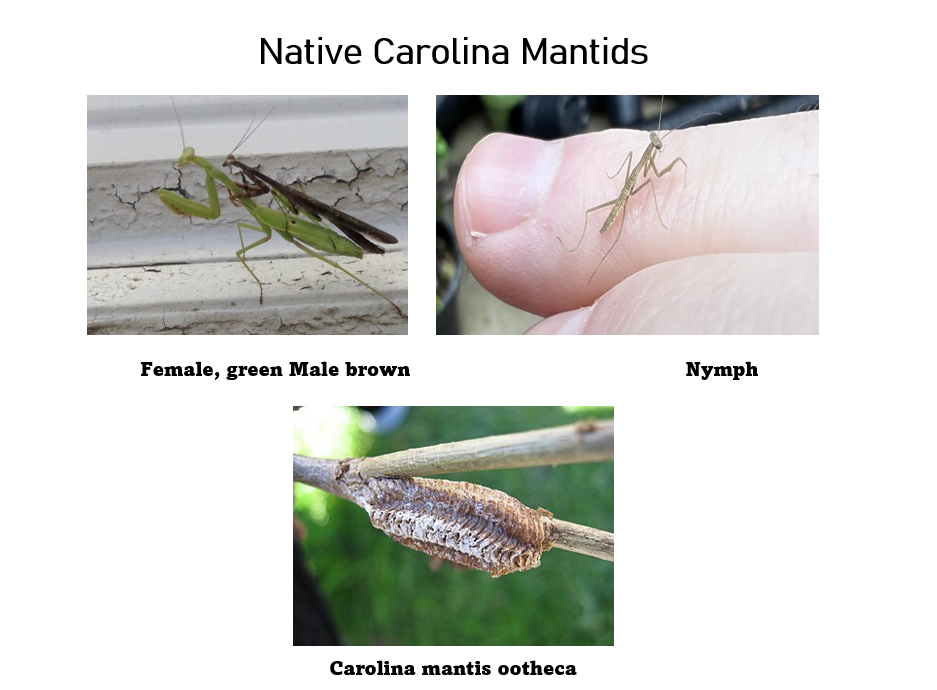
The praying mantis specializes in preying, often referred to as the perfect insect killing machine. The native Carolina mantis is very common throughout Texas. They grow to 2 to 3” long. They were blessed with an elongated thorax (like a neck) allowing them to turn their heads almost 360 degrees. This ability along with their three single eyes and two large compound eyes means they can easily spot prey. Their forelegs fold like a pocket knife, ending in sharp hooks used to capture and eat their victims. They are also well-camouflaged with their green to gray/brown coloration (which can alter to match their hiding place in foliage). Besides daytime hunting for aphids, mites, caterpillars, and beetles, they also feed at night on moths and are fast enough to catch flies and mosquitoes.
Native mantids begin life as one of 300 eggs, which the female encases in afoamy secretion, from glands on her abdomen, that hardens into an ootheca, a Styrofoam-like case. These rectangular casings are about 3/8” wide by 1” long, with rounded corners. The color can vary from tan to white on top with darker sides. The casing is smooth with a sequence of light brown striping. She lays her eggs on twigs or vines from November through May each year. The ootheca protects the eggs through the winter. The eggs hatch the mantis nymph, which look like small, wingless adults. The nymphs molt up to 10 times, growing larger as they go through each instar. The nymphs eat small prey and even each other. Once they reach adulthood and grow wings, they will live for about one year, or from spring to fall in cold regions. Females live longer than males. In fall, when mating, the male cautiously approaches the female, performing mating rituals so the female won’t attack him. Sometimes, the female eats the male during or after mating, and then, while mating, the female often bites off the male’s head and devours it, giving her extra nutrition. The female lives a few weeks after mating and laying the next generation. Mantids are indiscriminate in their feeding, sometimes eating beneficials. But Praying Mantis are nature’s way of seeking ecological balance and they also eat many garden and crop pests.
Native mantids mostly eat crickets, grasshoppers, beetles, cockroaches, fruit flies, flies, mosquitoes, caterpillars and moths and are less likely to prey on beneficial insects and each other than their invasive counterparts. Their populations are being decimated by the invasive mantis as the Carolina mantis can’t compete with the much more powerful invasive species.
Natural Predators
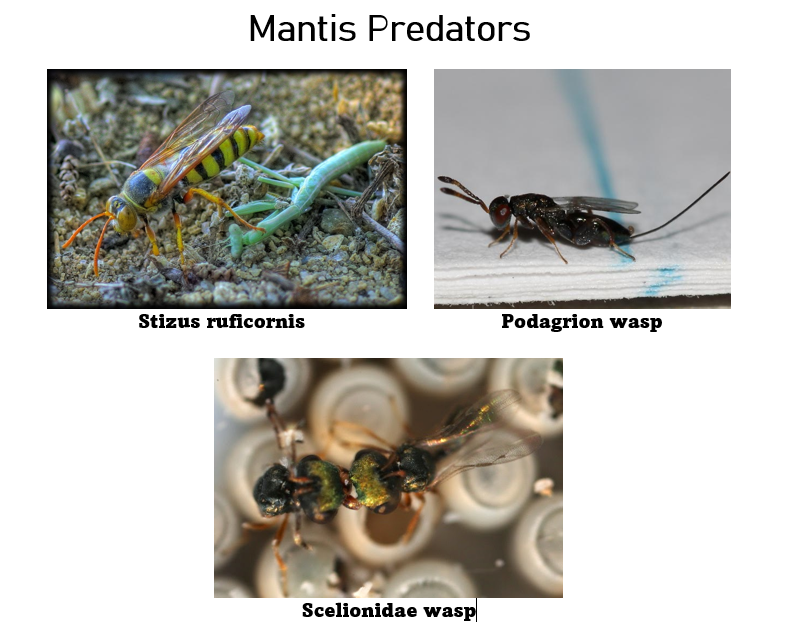
One species of wasp who prey on mantids, Stizus ruficornis, is a yellow and black sand wasp who grows to 1-1/3”. This wasp paralyzes the mantid and drags it into her in-ground nest. There, she lays her legs on the mantids’ thorax to feed her young when they hatch. They also prey on grasshoppers and crickets. Mantids are also preyed upon by birds and bats.
They can also be attacked by Scelionid wasps (Mantidophaga). The adult wasp lives on a host Mantis, and, when the female lays her eggs, the Mantidophaga will lay its eggs into the ootheca as its being formed. The wasp larvae will feed on the unhatched Mantis eggs until the wasps pupate. Another predator is a parasitic wasp, Podagrion mantis. The adult female Podagrion finds already constructed ootheca and lays her eggs inside the casing by ‘drilling’ deep into it with her elongated ovipositor which can extend as long as the wasp’s body. The Podagrion’s larvae then eat the developing mantid embryos. They are known to mainly prey on galls, as well as mantis ootheca. They cause mortality in nearly 30% of mantid populations. Adults are dark to metallic green (in northern areas) to bronze (in southern areas) with yellow markings on antennae and legs
Invasive Mantids
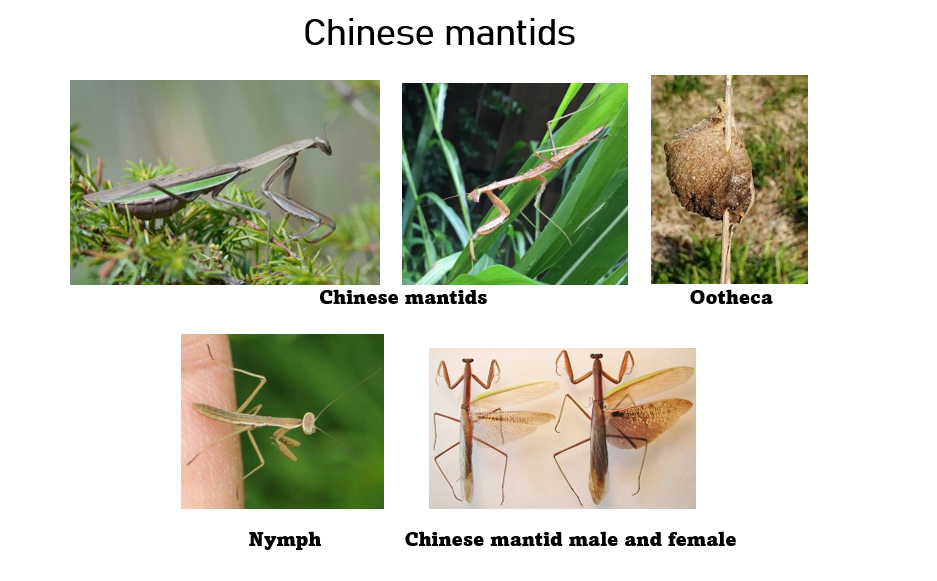
The invasive Chinese species (Tenodera aridifolia sinensis) are larger than the native Carolina mantis, can grow up to 5” long and are brown or green in color, camouflaging into their surroundings. Their ootheca is round to cube shaped, likened to a toasted marshmallow, straw colored and foamy. These are voracious predators who eat many native insects including beneficial pollinators. They’ve been observed eating reptiles, birds and amphibians. They are very competitive and aggressive, easily outcompeting our native species for food and prey. They can disrupt the ecosystem by killing off native insects, especially native mantis and beneficials. They were accidentally imported in 1896 in Pennsylvania. They were sold commercially for decades as a pest management tool but were eventually found to be useless in this purpose. This is due to the fact that they are considered ambush predators who attack anything they can reach; thus they are considered pests.
The invasive European mantis, (Mantis religiosa) grow to 3-4” long and are much greener than the Chinese mantis and they are also very aggressive and indiscriminate predators. They have a ‘bullseye’ under the foreleg. These invasives were imported for control of the gypsy moth. Their egg cases are similar in shape to the Carolina mantis’, but they are not as flat and smooth in texture and are solid pale brown with no striping. Like the Chinese mantis, the European mantis eat large numbers of pollinators and other native insects including the Carolina mantis.
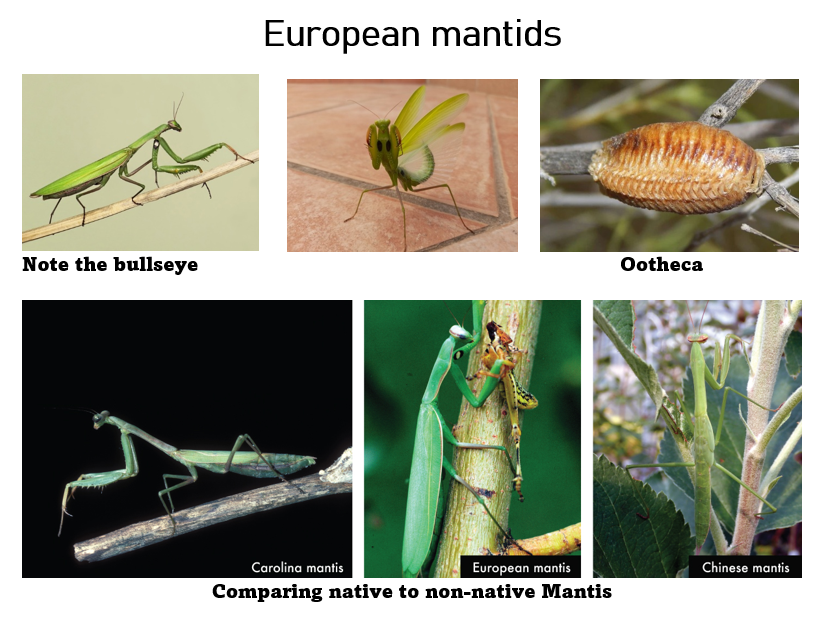
In many parts of the U.S., native Carolina mantis are in decline due to competition with the non-native, invasive mantis species. The best way to control the invasive mantids is to destroy their egg cases (ootheca) of both the European and Chinese mantis before they hatch. Unfortunately, some nurseries and pet stores have helped spread the invasive mantis by selling them as ‘pest controllers’ and pets.
The Big Country Master Gardener Association presents free education programs every month. There is a program at 6:00 p.m. on the 1st Tuesday of the month at the Abilene Public Library South Branch in the Mall of Abilene, and the same program is presented again at 10:00 a.m. on the 2nd Friday of the month at the Abilene Public Library main branch in downtown Abilene. We also have a Master Gardener Saturday Seminar from 9:00 a.m. to 12:00 noon on the last Saturday of the month from February through August in the Taylor County Extension Office Conference Room. The theme for the monthly BCMGA Library and Saturday Seminar presentations in 2025 is “The Year of the Garden.”
If you have any gardening questions, call the Taylor County Extension Office at 325-672-6048 or email us at mgardeners@yahoo.com. We hope you visit bcmgtx.org for information on all Big Country Master Gardener events, like us on BCMGA Facebook, and check out training presentations on the BCMGA YouTube channel. We are here to help you.