
By Kathy Feagan
Brown Assassin Bugs (Prirontis modesta) are true bugs (Class: Insecta/Order: Hemiptera), maturing to about 3/4” long. These slender, oval, light brown (to sometimes almost red/black) assassin bugs are common throughout the southeastern U.S. to Texas, Mexico , the Caribbean and South America. The Brown Assassin Bug has a long head, antennae, and body as well as six long legs. It has beady eyes and the long, hinged proboscis used for paralyzing, exterminating and eating prey. Their plain, brown coloration helps them camouflage in leaves and dirt. They have a noticeable scutellum (triangular plate) between the head and wings. They do not fly well but are very fast, scurrying on the ground. They largely feed on aphids, caterpillars, leafhoppers, and beetles. Females lay clusters of eggs on leaves, bark and stems of flowers. The hatched nymphs look a bit spider-like and are born predators of small pests. Adults live for several months, mating and laying eggs through the summer.
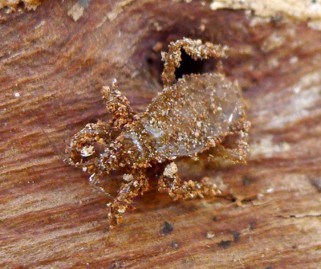
By Jimena de la Fpntera, Flickr
https://www.flickr.com/photos/43272765@N04/13385018933
Masked Hunter Assassin Bug (Reduvius personatus) receive their common name due to their nymph’s habit of using dust for disguise. They are day and nighttime predators of small arthropods like lacewings, carpet beetles, silverfish, earwigs, woodlice, termites and bed bugs. They are often found in homes with bed bug infestations. Through 5 instars, taking several months, nymph’s overwinter in sheltered areas and inside homes, stalking prey. They do not feed on humans but if endangered, they can painfully stab you with their proboscis (beak). They use their proboscis to stab, paralyze, kill and consume the liquified remnants of their prey. Masked hunters are brown to black, usually around ¾” long. Adults have a long head with a three segmented “beak” and long antennae. Nymphs are usually light colored from dust. Nymphs secrete a sticky substance all over their bodies so dirt, debris and dust cover and stick to their bodies. They use their fan-like structures on their hind legs to distribute the dirt and dust. They form two layers; the first of fine particles and the second, outer layer of larger, coarser materials. Adults are good fliers and very attracted to lights at night. They die after summer. They are native to west Asia and Europe but were introduced to the U.S. in the 1800’s and are now found throughout Central and Eastern U.S.
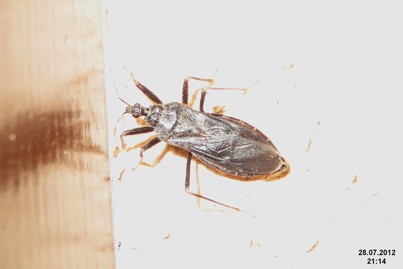
“Masked hunter (NH)” by David Short, CC BY 2.0
https://openverse.org/image/f5708e84-6b6e-44be-b9b4-67fa63b20f25?q=Masked+hunter+assassin+bug&p=5
Red Corsair Assassin Bugs (Sirthenea carinata) are found in North, Central and South America. They are species corsair in family Reduviidae, part of the true bug family. They are known for their vigorous strength and hardy builds. They have wings, long bodies with brown/black to orange/yellow markings with borders of orange to yellow stripes. They are sometimes called “two-spotted corsairs” due to their colorations that line up to a single mark when they close their wings. Like all Assassin Bugs, they tuck their proboscis under their heads until they attack, paralyze, kill and suck out the insides of prey. Nymphs feed on small crickets, small insects, eggs and insect larvae. Adults primarily feed on mole crickets and are also voracious pursuers of large insects, caterpillars, larvae and spiders, as well as many garden pests like aphids and spider mites. They are active during the day and hide in soil, under stones, leaves and debris. They continue to be active at night and are drawn to lights. Adults use their powerful forelegs for grabbing, capturing and consuming prey. They actively hunt along the ground. Their main predators are birds, bats, lizards, rodents and spiders. Ants, birds and lizards also eat their larvae.
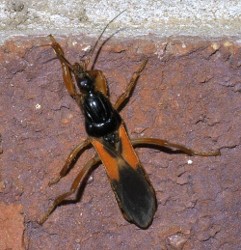
xpda, CC BY-SA 4.0 <https://creativecommons.org/licenses/by-sa/4.0>, via Wikimedia Commons
https://commons.wikimedia.org/w/index.php?curid=64912919
The Eastern Bee Assassin (Apiomerus crassipes) is considered a beneficial predator and is found throughout Texas. They are also found throughout central and eastern Canada and the U.S. and into Mexico. They are ½ to ¾” long with dark brown to black bodies with yellow and red markings on the sides of the abdomen. They also have noticeable upright hairs. Thread-legged Their bright markings discourage predators. They are known for hunting honey bees as well as many pests like ants, caterpillars, aphids, and mosquitoes. These are strong fliers, unlike most assassin bugs. They coat their forelegs with resins as a ‘glue’ for capturing prey. They then use their sticky front legs to capture and hold on to prey. Like other assassin bugs, they inject toxins, with their sharp proboscis, to paralyze, kill and liquify the insides of their prey. They then suck out all of the liquified remains. They stalk among flowers that are preferred by bees, flies and many pests. Their predators include spiders, toads, frogs and birds. The females lay their brown, cylindrical eggs in masses on the undersides of leaves, plants, stems and even tree bark. Once the wingless nymphs hatch, they remain on the leaves, hunting while going through 5 instars. Adults are found in spring through summer closer to the ground, usually hiding in debris, or on the stems of flowering plants which pollinators prefer. They are active during days and are also active at night, especially around lights.
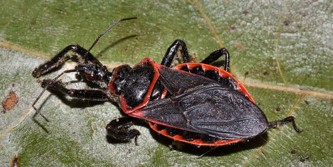
By Gordon C. Snelling
https://www.inaturalist.org/photos/143758536?size=medium
Horned Assassin Bug (Repipta Taurus) are sometimes called Red Bull Assassin Bugs and they are most active in mid-summer. They grow to about ½” long. Females lay their brown eggs in clusters in plant debris, leaves and stems of plants. The eggs hatch after about 10 days and the nymphs are noticeably swaybacked with the same red/orange and black coloration as adults, allowing them to camouflage around milkweeds. Their coloration mimics the very distasteful milkweed bug and discourages predators. After they go through their 5 instars, they become adults. Both nymphs and adults feed on many garden pests. Adults and nymphs are very active predators of mosquitoes, beetles, flies, caterpillars and other soft bodied insects and bugs. They unfurl their proboscis and use the sharp stylets first as a syringe to paralyze prey, then a second stylist to suck out and eat the liquified insides of their prey. They have four prominent, long spines on the rear of the pronotum (behind the head). These spines protect its head and thorax. They produce several generations each year in the warm Texas climate. Adults overwinter in plant debris and leaves before returning to hunt and mate each spring.
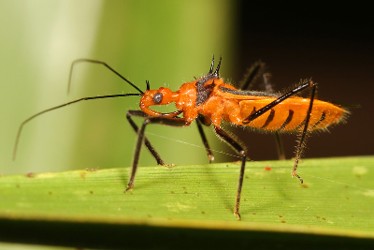
By Judy Gallagher “Red Bull Assassin Bug – Repipta taurus, Sapelo Island, Georgia” by Judy Gallagher, CC BY 2.0
Thread-legged Assassin bugs (Stenolemus schwarzii) are very long (1 to 1-1/2” long), spindly and look very delicate. But their front legs are quite raptorial, enabling easy prey capture. They can be mistaken for a huge mosquito or a walking bug. Their thin, long bodies and legs, tends to minimize their weight, allowing them to distribute themselves over multiple web strings without breaking them. Thread-legged Assassins hunt spiders by plucking the web with their antennae, mimicking trapped prey. Once the spider comes close, they strike. Females lay their eggs onto spider webs. When the egg hatch they begin luring and hunting spiders as they develop through 5 instars, becoming darker with each molt. Once they reach adulthood, they develop wings and begin laying the next generation. This cycle is completed within a few months, so many generations are born. Many live year-round in warmest climates. They are found wherever spider webs are, in barns, sheds, eaves, trees and brush. They employ incredible hunting strategies – stalking and luring. They are most active in the warmest months when spiders proliferate. These assassin bugs are mostly nocturnal and are also drawn to lights at night. They do fly awkward, short, low distances with their short wings.
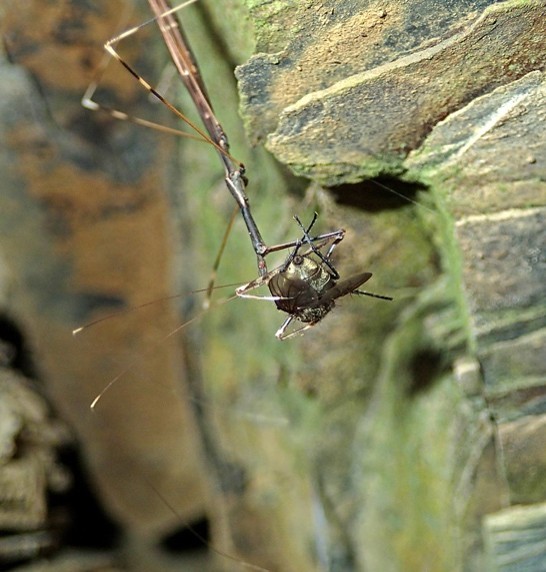
By James St. John, en.wikipedia.org/wiki/Emesaya_brevipennisBy James St. John, en.wikipedia.org/wiki/Emesaya_brevipennis