
By Big Country Master Gardener, Kathy Feagan
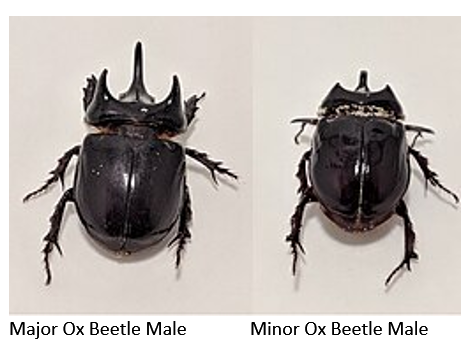
Ox/Elephant Beetles (Strategus aloeus) are one of the largest and most fearsome looking beetles, common from Florida to Arizona and south to South America. The warmer the climate, the more Ox Beetles will be found. They are also sometimes called Southwestern or Elephant Beetles. Ox Beetles grow to 2 to 2-1/2” long (without the horns) and are brownish/yellow to a green/gray/black coloration with dark spots. There actually are Minor and Major within the species.
Major male Ox Beetles have three large horns, behind their heads. with the middle horn being the longest. They resemble a triceratops dinosaur. Minor males have three horns with the two in the back being stubby and small. Females have a very short horn which they use for excavating and protection. They live for about 6 months, active from May to November. They dig deep holes for hiding during the day. They mostly eat flowers, leaves and fruits, but prefer apples. At night, they are very attracted to lights. Females lay eggs singly in decayed wood or sandy soil. They layer in leaves and debris for camouflage, protection and temperature control to help the eggs hatch and mature.
Kajmana, CC BY-SA 4.0 <https://creativecommons.org/licenses/by-sa/4.0>, via Wikimedia Commons

The eggs become large grubs, going from egg to larva, to pupa to adult, and reach yellow to orange pupal stage within 4-6 months, then develop into adults within a year. The large, white C-shaped grubs look like June beetle grubs but differ in being very beneficial! They live in rotting wood and high organic material. They are often found in compost and planting materials. By eating rotted wood, sap, decayed roots and leaves, they are very beneficial in recycling organic matter. Because they are attracted to apples, many gardeners encourage them to help decompose their compost bins by throwing apple slices in for them to eat, so they will stay awhile!
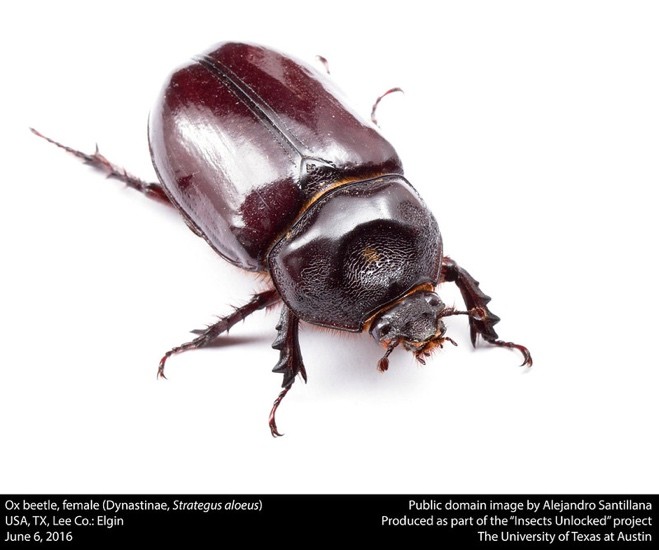
Public Domain by Alejandro Santillana, Insects Unlocked University of Texas
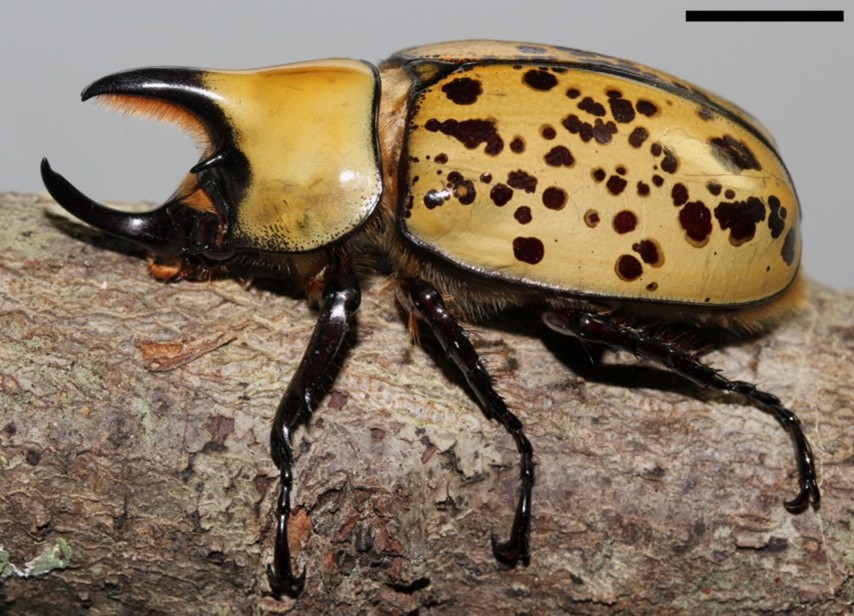
Eastern Hercules “Rhinoceros” Beetles (Dynastes tityus) are another of the largest and heaviest scarab beetle species in Texas. They are thought to be one of the strongest insects on Earth. A study found they can carry close to 100 times their weight. But, Dung Beetles are stronger, able to move 1,140 times their weight. Rhinoceros Beetles use their strength and horns for battling other males for feeding sites, which attract females. They can grow to 2-1/2” long, are green/gray to tan/brown with dark spots, and mostly feed on decaying wood.
Rhinoceros Beetle – By David Hill

Their coloration can change from yellow/green to browns when they move from low humidity areas to high humidity areas. In drier environments, their layers fill with air and changes their reflectiveness. When they are in high humidity areas, the air is replaced with water and this intensifies their reflectiveness. The higher the humidity, the stronger and darker the beetles become. They are actually very beneficial in decomposing wood and recycling nutrients. They highly prefer Ash trees and hardwood trees like oak. Their two “horns” consist of one long, forward pointing pronotal horn from the thorax and a smaller upward pointing clypeal horn extending from its head. Females are smaller than males and have no horns. The length of their horns is determined by the volume of wood consumed by the larvae. Mating is a long process, often taking minutes to several hours – even days -during the June to July mating season. Males emit a fragrance similar to blueberries to attract females. Competition with other males is very intense, using their horns to battle rivals. Their battles include fiercely flipping and pushing rivals away. After mating, females search for moist, decaying areas to lay up to 100 eggs in her lifetime, usually in dirt at the base or crevices of trees (near decaying wood). This provides shelter and future nourishment for larvae. After hatching, they spend at least a year as larvae, molting three times as they grow larger. They finally enter pupa stage in late summer and then emerge as adults. The larvae’s nearly ½” rectangular fecal pellets can be found in woody debris and are also used for the larvae’s pupal stage. Adults overwinter underground then emerge the next summer. They live for about a year. Larvae are very large (growing up to 4-1/2” long through three instars), C-shaped creamy grubs with a brown head, and three pairs of legs. Born with chewing mouthpieces, they are often found in compost piles and tree debris. The grubs spend 1 to 2 years feeding on wood and fungi before pupating. Their larvae stage (first instar) takes about 50 days, the second instar lasts about 56 days and the third instar from 1 to 1-1/2 years. They are usually yellowish before pupating. They are active in summer, eating rotting wood and organic materials. Larvae and adults have many predators among soil-dwelling and surface-foraging animals like skunks, moles, birds, snakes, possums, ground beetles, centipedes and spiders. They are also susceptible to parasitic flies, nematodes and fungal pathogens. Adults are able to camouflage with the colors of tree bark they inhabit. Larvae burrow deeply into decaying wood to hide and protect themselves. Both larvae and adults can bite and scratch predators or people while handled or threatened. Adults live for 3 to 6 months and are nocturnal, eat very little but do occasionally munch on leaves, sap, fruit and decaying vegetation. They live for 2 to 3 years, from egg to adult.
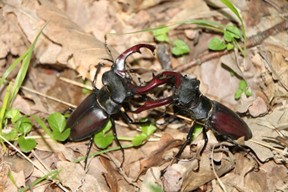
Stag Beetles (stag beetle) are relatively harmless, reddish-brown and grow to 1-1/2”, including their large jaws. Males have large mandibles that look like antlers. Females have smaller jaws. They live in damp or decaying trees, preferring hackberry, oaks and willows. They are nocturnal and are attracted to lights. Their 3” long larvae spend years inside rotting wood before maturing to adults.
Stag Beetles fighting – by Emilian Robert Vicol CC BY 2.o
The larvae (grubs) are considered beneficial for breaking down wood with a fungi in their gut. Fully grown larvae make a cocoon in soil to pupate over several months. Adults appear in late spring, feed on leaves and fungi, and live only a few weeks, living only to mate. Females lay eggs in soil near rotting stumps or logs. These beetles are somewhat scarce in Texas and are not considered a pest.
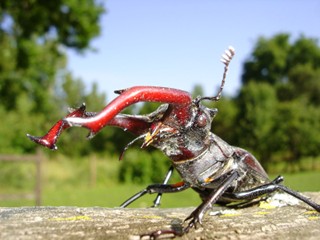
Stag Beetle, Male “stag-beetle” by g_kovacs licensed under CC BY 2.0.
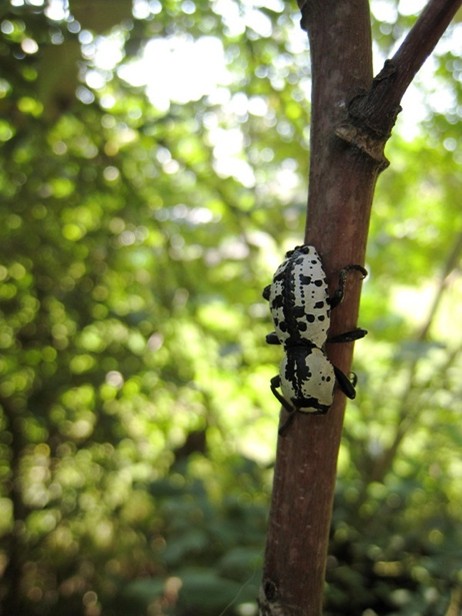
Ironclad Beetles (Zopherinae nodulosus haldemani) are found in East and Central Texas and south to Mexico. They have a distinctive, mottled black and white, very hard exoskeleton. Their shell is so tough they survive being stepped on and even being run over by automobiles. Most collectors have to drill a hole in them in order to pin them for display. Ironclad Beetles inspired BAE System Engineers to build suspensions for combat vehicles using flexible titanium alloy (to imitate Ironclad Beetle shells) designed to pop back into shape after explosions. They are found mostly on pecan, elm and oak trees feeding on lichens and fungi on tree trunks.
Ironclad Beetle Bruce Turner’s photo, licensed as CC BY 2.0
They are 5/8 to 1-3/16” long and protect themselves by “playing dead”. They are flightless and active from late spring to fall. Eggs are laid in crevices in the tree bark where the hatched larvae eat lichens while growing and passing through instars. They then go through Pupal stage within the safety of the crevice, finally emerging as adults who can live for several years. They are also called Lazarus Bugs due to their ability to appear dead in the bottom of water buckets, then revive when removed, and walk away. They are not threatening to people or to gardens.
If you have any questions, call the Taylor County Extension Office at 325-672-6048 or email us at mgardeners@yahoo.com. We hope you visit bcmgtx.org for all Big Country Master Gardener information and events, like us on BCMGA Facebook, and check out training presentations on BCMGA YouTube. We are here to help you.
Until next week, Happy Gardening!