
For the last several years, there has been an appeal to gardeners and insect lovers to plant milkweed plants to encourage the monarchs which have been in decline. Monarchs travel through our West Texas neck of the hills and plateaus on their migration route from the upper Midwest down into Mexico and back. Over the next few weeks, we’ll be seeing them on their way south. In May, we see them heading north.
They only lay their eggs on Milkweed plants. The eggs hatch and the larvae/caterpillars feed on the leaves of the Milkweeds. The full caterpillars then pupate on a Milkweed plant, and when conditions are just right, they transform into a beautiful black and orange patterned butterfly. But of all the many Milkweed plants found in the United States, and out of a number of species that grow in Texas, which ones are the ones the Monarchs love best and are found here?
There are several varieties of Milkweed that grow here in West Texas that the monarchs favor. Their favorite Milkweed is the Antelope Horn Milkweed which is native to Texas. They lay eggs on this plant, which hatch to produce caterpillars that eat its leaves, and the adults drink nectar from its flowers. This variety of Milkweed has a long taproot and long, narrow leaves and is often found in pastures and along roadsides. It blooms from April through November, providing a great source of food for the Monarchs coming through from the south enroute to the north, and laying eggs along the way.
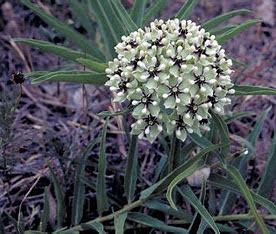
The Antelope Horn Milkweed is a native Milkweed to our area of Texas. It grows in full sun in quickly draining sandy and loamy soil, and even in rocky soils. It grows from 1 to 2 feet tall and sprawls out to 2 feet wide. Its flowers start as star-shaped buds in round clusters on flower stalks and open up with five cream or greenish petals with purple-tinted cuplike structures inside them that hold the nectar. This nectar is a favorite for the Monarch butterflies, but many other butterflies, and bees, hummingbirds, and a variety of other insects enjoy the sweetness and the nourishment.

When the flowers develop seeds, we can see why the plant is called “Antelope Horn.” The green seed pods are long and pointed, and turn a light camel-brown–just like an antelope’s horn. When the seeds are ripe, and the temperatures are ideal, the pods burst open, and the small brown oval to tear-drop shaped seeds loosen and pop out. The seeds are attached to white parachute-like tufts and are easily carried on the breeze to fall here and there, and the cycle goes on. We can plant the seeds from this Milkweed by dropping them in soil and spreading about 1/8 inch of loose soil over them in late summer or in the fall. After a normal West Texas winter, with some nights and days of freezing temperatures, they will be stratified sufficiently to germinate.

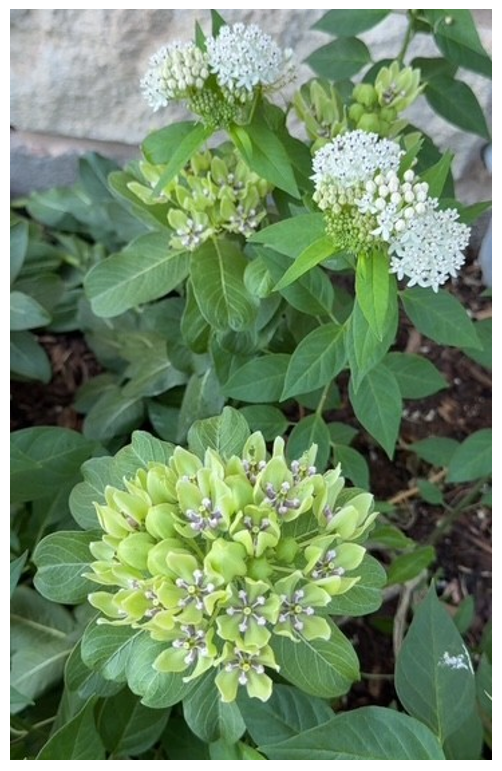
Monarchs also enjoy the nectar and the leaves of the Green Milkweed, which is a little different than the Antelope Horn. It is also native to Texas. This plant grows taller and is more upright, and forms more of a vase-like shape. Most of the plant is green, thus its name. It has leaves that are wider than those of the Antelope Horn Milkweed, and more rounded on the tips. The buds of this plant are tall and roundish, and they open into flowers of five petals in a cluster that is somewhat loose, and are not as showy as those of the Antelope Horn Milkweed. Theses flowers vary in color from cream to green, with lavender or rose-pink cups around them, and may bloom from April into October. Green Milkweed prefers to grow in richer soils than the Antelope Horn, but will grow in almost any type of soil. It does best in full sun, but can handle some shade during the day. Its seed pods are very similar to those of the Antelope Horn.
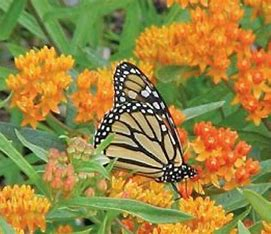
Another Milkweed that Monarchs will lay their eggs on and feed on is the Tropical Milkweed. As its name implies, it is not native to Texas. The Tropical Milkweed is native to Central and South America, the Caribbean and Mexico, but has become naturalized. It does best in full sun. It grows about 2-4 feet tall in almost any soil except clay, and produces showy red, orange and yellow flowers. It has long green leaves and grows upright. It produces roots that are fibrous. Because we in West Texas get frost and heavy freezes, this plant is considered an annual, as it is a tender plant. The Tropical Milkweed produces seed pods similar to the native ones mentioned. These seeds may be collected and used to propagate new plants in the spring when temperatures are warm, or may be left to drift and produce new plants wherever they land.

The Tropical Milkweed may harbor a parasite that stunts the life cycle of the Monarchs. Tropical Milkweeds may also flower longer into the fall, causing some of the Monarch populations to delay their journey to Mexico. This delay may be disastrous if freezing temperatures arrive before they leave to finish their trip.
So, either coming or going, Milkweeds are the plant that the Monarchs need in order to migrate the many miles from their summer home to their winter home and back again. We may see the Monarchs resting in trees along the route. But they need nourishment, and our Milkweed gardens are just the place to provide some of their sustenance.
An interesting fact about Milkweeds is that they all produce a milky substance that is somewhat irritating to people and to most other living creatures, but the Monarchs can tolerate it. In fact, the toxin is found in their eggs and in their bodies. This may be the way they are usually not the prey to any other living creature.
The Big Country Master Gardener Association presents free education programs every month. There is a program at 6:00 p.m. on the 1st Tuesday of the month at the Abilene Public Library South Branch in the Mall of Abilene, and the same program is presented again at 10:00 a.m. on the 2nd Friday of the month at the Abilene Public Library main branch in downtown Abilene.
We are here to help you. If you have any questions, call the Taylor County Extension Office at 325-672-6048 or email us at bcmgardeners@yahoo.com. We hope you will also visit our Facebook page, our website at bcmgtx.org, and the BCMGA YouTube channel for all Big Country Master Gardener information, events, and training.
Until next week, happy gardening!