
By Grace Broyles
The fig tree is a a fruit tree in the Mulberry family of trees that originated in the Middle East and Western Asia and was moved throughout the Mediterranean region and eventually to the Americas. Jackfruit and Breadfruit are included in this family, as is the Osage Orange. This family of trees almost all have a milky sap, which can be an irritant.
We know about the Fruitless Mulberry, used for many years as a quick-growing shade tree, but the fruiting varieties of Mulberries have been frowned upon in cities and towns due to their fruit drop and staining wherever they’re growing. As for fig trees, Ficus carica, they look different than Mulberry trees and produce fruit that looks different than that of the Mulberry. They grow well in West Central Texas and they are not as messy as the Mulberry.
Fig trees are multi-trunked and shallow-rooted and, depending on the variety, can grow up to 20 feet tall. They have large leaves with 3-5 lobes that have thick veins. They grow relatively quickly in full sun in moist sandy-loam soil that has good drainage, and will continue to do well when protected in harsh winters and summers. Soil that is too sandy or has too much clay can be easily amended by adding organic materials and/or perlite to provide appropriate drainage.
Fig trees should be planted in the fall when the tree is dormant. Young trees get the best start in the ground before winter begins and the tree breaks dormancy sometime in the early spring. The best place to plant them is on the south or east side of a structure where there is protection from the north winds and the coldest temperatures. It is best to plant away from the structure if it is a home – the tree can get very large and wide over time, including the circumference of the roots. Fig trees do best when some of the trunks are removed to leave about 5 to 7 strong trunks.
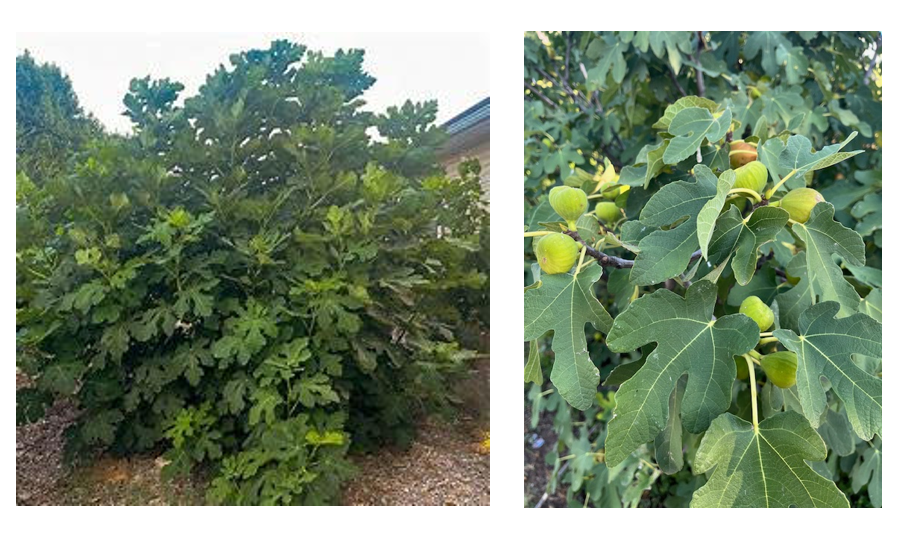
Fig trees break winter dormancy when temperatures warm up. They do not need a specific number of chill hours (hours below 45 degrees Fahrenheit) to begin leafing out and producing fruit. In fact, their blossoms are formed on the wall of the fruit inside the fruit and do not need to be pollinated. It takes 2 -3 years for a fig tree to begin producing fruit when planted from a cutting or from a nursery plant, and the tiny fruits are formed as the tree leafs out. It takes even longer when planted from a seed.
Fig trees produce two crops in warmer climates. The first crop is in early summer – on last year’s wood. This is called the Breba crop. The main crop occurs in late summer into fall on the new growth. The best fruit from a fig tree are the ones left on the tree to ripen fully. This may be difficult due to birds and squirrels, and maybe even deer, competing for the fruit. Green figs turn their mature color, depending on the variety, as they ripen. When the mature color is uniform and the fig feels soft to the touch, the fig is ripe. The stem begins to droop as it softens. There may even be a sweet aroma about it, and even a bit of sap on the bottom at the “eye.” Pick the fig by lifting up and it should fall gently off into your hand.To keep the competition at bay, fig trees can be covered with netting, or each fig can be bagged with a small bag made from tulle or other porous material.
The best types of fig trees in our area are the Celeste and the Texas Everlasting (also called Brown Turkey). Other types of figs to try in our area of West Texas are Alma, LSU Purple, and Black Mission. The Celeste is a small to medium-sized tree that can grow to 15 feet high. The fruit is small to medium and turns light brown to violet-purple when ripe. The meat is strawberry-pink and very sweet, with a few small seeds. It produces fruit from late June into early July and does not have a Breda crop. It is susceptible to changes in summer temperatures, often dropping fruit and leaves when temperatures get high and it’s dry. The Celeste does best when moisture and temperatures are more consistent. Spreading 3-4 inches of mulch under the tree to the dripline is a help in the summer and also in the winter. Watering once a week, deeply and slowly, is best. The Celeste can be pruned to shape it in the summer. In the winter, the dead and diseased wood should be removed. This tree should be fertilized lightly in the spring and after fruiting.
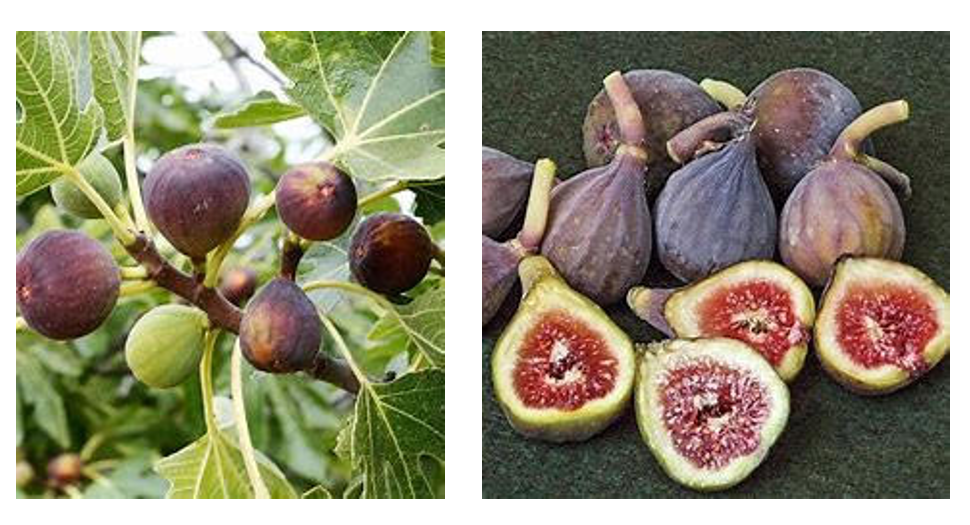
The Texas Everlasting Fig tree is the other fig tree that grows well here. This fig tree can grow up to 20 feet tall if left to grow naturally. The pear-shaped fruit is larger than the Celeste (up to 2 inches long) and become brownish-yellow or even deep-purple when ripe. The meat is rose-pink in color and is very sweet, with very few seeds. The fruit is great for eating fresh, for use in baking and to make jams and jellies. The Texas Everlasting fig tree produces fruit two times a summer – the Breda crop in May, and the main crop from June into August, or even later. This fig does best when pruned by a foot in the winter and all dead or diseased branches removed.
This fig is also a great tree to add interest to the landscape and can planted in a bed along with perennials where it provides a contrast in color and shape. The Texas Everlasting also needs consistent watering and a good layer of mulch under it for the fruit to reach maturity and fill out well. A light fertilization may be done in the spring and after harvesting the fruit.
Fig leaves may also be used to flavor meats and casserole type dishes as a wrap or steeped in liquids to flavor foods such as ice creams and puddings or teas.
Oh, Fig! I forgot to mention that it is difficult to kill a fig! Even when a fig tree dies to the ground because of a harsh winter freeze, or an exceptionally dry summer, when spring comes, from the root a shoot will appear! The dead material can be cut off and tossed into the debris pile and, in a couple of years, you’ll get some good figs once more.
The Big Country Master Gardener Association presents free education programs every month. There is a program at 6:00 p.m. on the 1st Tuesday of the month at the Abilene Public Library South Branch in the Mall of Abilene, and the same program is presented again at 10:00 a.m. on the 2nd Friday of the month at the Abilene Public Library main branch in downtown Abilene. We also have a Master Gardener Saturday Seminar from 9:00 a.m. to 12:00 noon on the last Saturday of the month from February through August in the Taylor County Extension Office Conference Room. The theme for the monthly BCMGA Library and Saturday Seminar presentations in 2025 is “The Year of the Garden.”
We are here to help you. If you have any questions, call the Taylor County Extension Office at 325-672-6048 or email us at bcmgardeners@yahoo.com. We hope you will also visit our Facebook page, our website at bcmgtx.org, and the BCMGA YouTube channel for all Big Country Master Gardener information, events, and training.
Until next week, happy gardening!