
A favorite fall vacation is traveling to Virginia to visit family and spend time being a “Leaf Peeper.” There’s something magical about looking out over the countryside and seeing a patchwork of gold, orange, crimson, and green. Seeing all that diversity gets me thinking about how to bring more fall color to my yard. There’s no better time than now to select a tree to plant. In fact, according to an arborist friend, trees can be planted successfully any month but July and August.
Purpose: What factors need to be considered in planting a tree? First, decide on the purpose of the tree. Will it provide cooling shade? If so, plant a tree on the South or West side of your home for maximum impact. Wrap the trunk of the tree with paper wrap for the first year if the bark will receive direct sun from the South or West. If you select a deciduous tree, you’ll have plenty of warming sunlight during the winter months. Do you want the tree to provide a focal point for your property? Perhaps you envision a beautiful row of trees lining a drive or entry. A good choice would be crape myrtle, Chinese Pistache, Chinquapin Oak, or Mexican Plum. If you need the tree for privacy, select one that is an evergreen, such as a pine or hollies.
Mature Size: Second, be sure to consider the mature size of the tree. Consider trees that may already be on the property, making sure that the new tree has sufficient space to grow both vertically and horizontally. Are there power lines in the area? Keep in mind the mature size of the tree. In most cities, the tree trimmers hired by power companies may trim trees within 15 feet of the power lines. Aggressive trimming results not only in an awkwardly shaped tree, but the tree often loses enough leaves to set it up for stress, especially if the trimming is done in summer.
Placement: Will the roots be in competition with sidewalks? Make sure to plant the tree at least 15 feet away from the house to avoid foundation issues and make sure that branches don’t rub house eaves and fascia. Make sure the tree has plenty of space for the trunk to grow. A mature tree trunk needs much more space than a young one. If the space is too small, tree roots will circle around and may “girdle” or bind the tree, bringing on an early decline and death. Tree roots extend much farther out than previously thought. Envision a goblet set on a dinner plate, with the goblet representing the tree and the plate representing the tree’s roots.
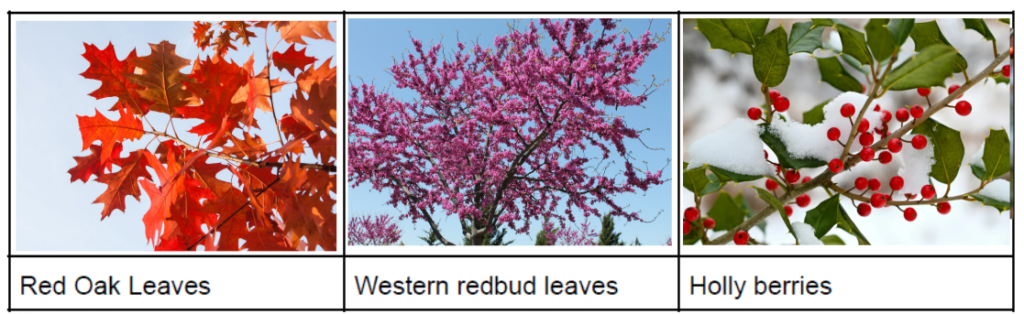
Aesthetics: A third factor is to think about the many beautiful aspects of trees. Do you want a tree with fall foliage? For red color, consider a Red Oak or Shantung Maple. Crapemyrtle and Sycamore have beautiful bark that provides interest once the leaves drop. Do you want a tree with spring flowers? Consider a Western Redbud or Red Buckeye. For winter berries, consider a Possumhaw Holly or Yaupon Holly.
Native and Texas Superstar first: Finally, consider planting a native tree or one that has been identified as a Texas Superstar. According to the USDA website, “a native plant is a plant that is a part of the balance of nature that has developed over hundreds or thousands of years in a particular region or ecosystem.” Additionally, “only plants found in this country before European settlement are considered to be native to the United States.” They provide habitats and food for migrating pollinators and invertebrates, and are well adapted to our climate conditions. These trees will be less susceptible to invasive insects, blight, and do not have the weaknesses of many introduced species. As a young child my parents planted many of those weaker introduced tree species, none of which survived beyond 10 years.
Once you have selected and purchased your tree, study the proper way to plant and mulch that tree to provide the best chance that it thrives. This resource is excellent: https://tfsweb.tamu.edu/ArborDay/PlantingSteps/
Two more resources for selecting trees are: https://texastreeplanting.tamu.edu/
http://texastreeid.tamu.edu/content/listOfTrees/
A beautiful tree is your gift to the future.
*Master Gardeners are volunteer educators certified and coordinated by the Texas A&M AgriLife Extension Service.
Ann Butler
Big Country Master Gardener