
By Big Country Master Gardener Kathy Feagan
Green Lacewings, consisting of many different species, are exceptionally beneficial and very common throughout Texas. Most common in Texas are Chrysoperla carnea (common green lacewings), Chrysoperla oculata (Goldeneye Lacewings), Chrysoperlaru filabris (Red-lipped green lacewings), and Chrysoperla comanche (Comanche Green Lacewings).
Common Green Lacewings (Chrysoperla carnea) are considered vitally beneficial for control of pests like caterpillars, aphids and mealybugs. These insects are also called ‘Aphid Lions’, due to their larvae’s consumption of so many pests, and are commercially sold for biological controls in gardens as well in commercial agriculture. It is estimated that each lacewing can consume up to 600 aphids! Adults are light green with a delicate body, long antennae, transparent elongated wings and bright gold eyes. They grow to ¾” long and are found in gardens, meadows, orchards, farms, greenhouses and fields throughout Texas. They are weak “fluttery” flyers of short distances and are attracted to lights at night. Adults feed on nectar, pollen and aphid honeydew. The real beneficial action begins when their larvae hatch. Oval, pale green eggs are laid singly at the end of silk stalks, to prevent cannibalism. As they mature the eggs turn gray. Within 3-6 days, the larvae hatch and become very active. Larvae are cream to yellowish, with rows of lengthwise dark spots, and look like tiny alligators. They are born with fully developed legs and sickle type jaws that suck and chew. Their jaws also have tubes which are used to inject a paralyzing venom into their prey before sucking prey dry. The venom, as well as enzymes in their jaws, also helps dissolve their prey for easier ingestion, they can be found on most vegetables, fruits and other crops that become infested with aphids. Besides eating aphids, Green Lacewings are also predators of spider mites, white flies, leafhopper eggs, thrips, moths, small caterpillars, beetle larvae, leaf miners and tobacco hornworms. After hatching, the larvae go through two instars within three weeks then the third instar spins a round silken cocoon, which camouflages on plants. Adults emerge within two weeks. Their life cycle speeds up depending on the temperatures so there can be anywhere from two to many generations born each year. Adult lacewings overwinter in debris at the edges of fields or gardens. From spring through summer, each female lays several hundred eggs, usually on twigs or leaves close to prey.
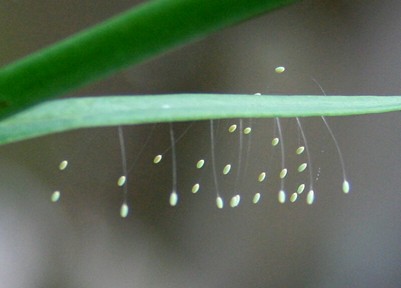
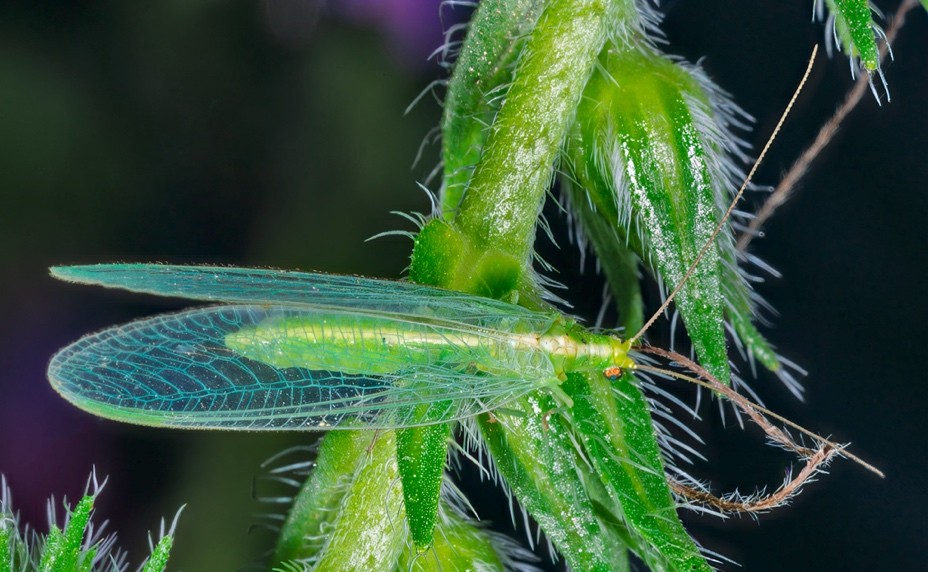
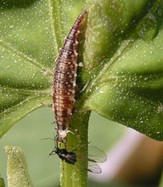
Pic1: Lacewing Eggs, laid singularly on silk stalks“Eggs – who laid eggs?” by joka2000 CC BY 2.0 Pic 2: Common Green Lacewing – By Didier Descouens, CCBY-SA 4.0 Pic 3: Green Lacewing larva – By Eric Steinert, CC BY-SA 3.0, via Wikimedia Commons
Goldeneye Lacewings(Chrysoperla oculata) have distinctly metallic, bright golden/copper eyes, and green bodies. They can be identified by a black band on the front of the head that runs underneath the antennal sockets and a red “Y” between and above the sockets and red encircling the second segment of each antenna. Larvae appear speckled with white and dark spots. This species overwinters as adults or in last stage (instar) larva in a silken cocoon in the soil. The larvae are voracious eaters of mites, aphids, whiteflies and mealybugs. They are found in vegetation, fields, gardens, and meadows among grass, shrubs and weeds.
_Chrysoperla_carnea_-_dorsal_view.jpg#/media/File:(MHNT)_Chrysoperla_carnea_-_dorsal_view.jpg)

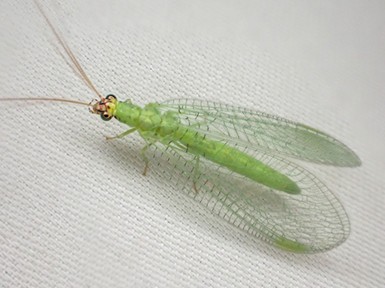
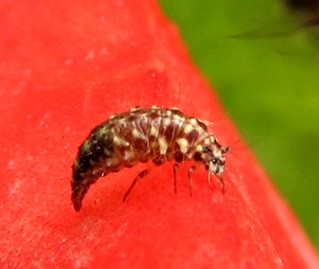
Pic 1: Goldeneye Lacewing – “Chrysopa oculate” byChloe and Revor Van Loon Pic 2: Goldeneye Lacewing Larva – “Green Lacewing Chrysopa oculate” by Jacy Lucier
Red-lipped green lacewings (Chrysoperla rufilabris) attack the eggs of aphids, scale, spider mites, whiteflies, mealybugs, psyllids and soft bodied insects. These native lacewings are considered to be exceedingly beneficial and are often used for control of pests. They are commercially sold in egg, larvae or adult stages. It is recommended that they be introduced in early spring for best pest control. They are known for their red cheeks.
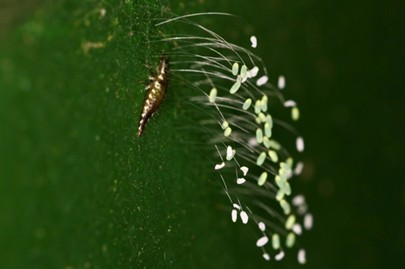
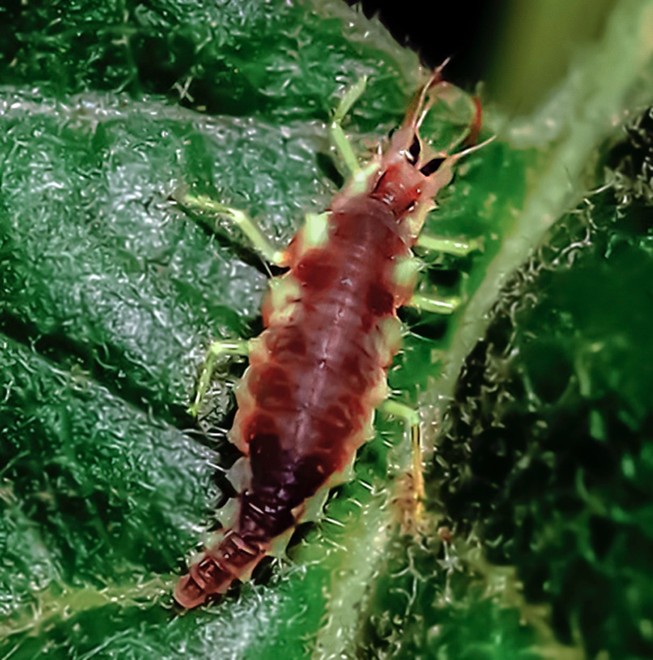
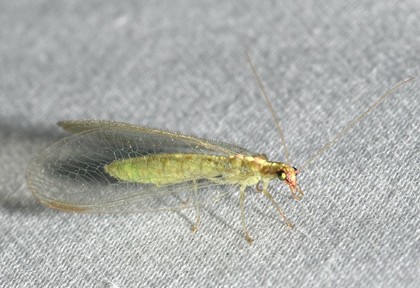
Pic 1: Red-lipped Lacewing eggs and larva – “Chrysoperrla rufliabris” by natureenthusiast05, CC BY-NC 4.o, Pic 2: Red-Lipped Lacewing Larva – By WanderingMogwai, CC Share Alike 4.0, Pic 3: Red-Lipped Lacewing – CC BY 2.0, Attribution 2.0 Generic
_larva.jpg)
Comanche Green Lacewings (Chrysoperla comanche) are predators of leaf hoppers, aphids and small pests. They are especially useful in vineyards for leafhopper control. These lacewings have red-striped cheeks and green cross veins on their wings. Comanche lacewings are Texas natives and most common in desert-type areas of Texas, Mexico, New Mexico, Oklahoma and Colorado. In mild climates, unlike other lacewings, these insects do not go dormant but remain active through the winter.
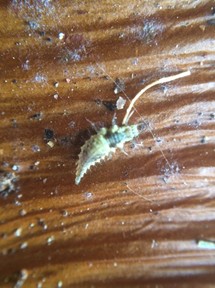
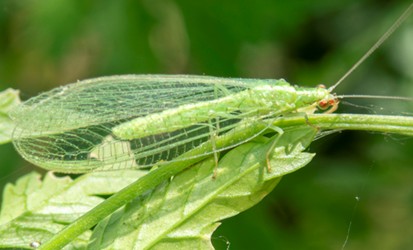
Pic 1: Comanche Lacewing Larva – “Chrysoperla comanche” by Lazarus CC BY 4.o, Pic 2: Comanche Lacewing – “Chrysoperla comanche” by Don Loarie, CC BY 4.0
The Big Country Master Gardener Association presents free education programs every month. There is a program at 6:00 p.m. on the 1st Tuesday of the month at the Abilene Public Library South Branch in the Mall of Abilene, and the same program is presented again at 10:00 a.m. on the 2nd Friday of the month at the Abilene Public Library main location. The Friday program at the Downtown Library will be suspended during the next couple of months while preparations are made for the library to move to its new location, but we will still provide the programs at the Mall Library location. Be sure to check our website to know when the Friday program will be held. We also have a Master Gardener Saturday Seminar from 9:00 a.m. to 12:00 noon on the last Saturday of the month from February through August in the Taylor County Extension Office Conference Room.
We are here to help you. If you have any questions, call the Taylor County Extension Office at 325-672-6048 or email us at bcmgardeners@yahoo.com. We hope you will visit our Facebook page, our website at bcmgtx.org, and the BCMGA YouTube channel for all Big Country Master Gardener information, events, and training.