By Stephanie McKee
The state of Texas offers an abundant array of beautiful and resilient plants for us to enjoy, plant and learn from. Two of the most popular categories are Native plants and Texas Superstar plants. To fully understand these plants, let’s first take a look at their definitions and key characteristics.
A Texas Native plant is defined as a plant that originated and evolved naturally in Texas. This simply means that it has grown and evolved in the state without human introduction or cultivation. These plants have adapted to the state’s climate, soils and ecosystems. They also form part of the natural balance with local wildlife, insects and other plants.
Some of the key characteristics of Texas Native plants may include the following:
- Naturally occurring: Not introduced by humans, intentionally or accidentally.
- Adapted to Texas conditions: Can thrive in local soil types, survive hot summers, occasional freezes and droughts.
- Supports wildlife: Provides food and habitat for native pollinators, birds and other animals.
- Low maintenance: Once established, these plants typically require less water, fertilizer and pest control.
- Ecosystem benefits: Help maintain soil health and prevent erosion.
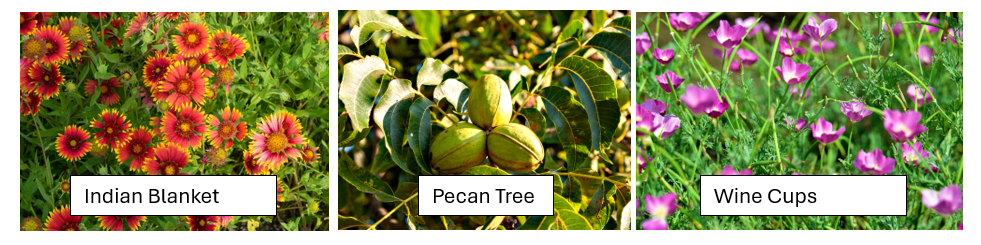
A few examples of Texas natives:
Texas A&M AgriLife Research/Texas A&M AgriLife Extension Service defines Texas Superstar plants as “specially recognized for superior performance in tough growing conditions in Texas.” Texas A&M AgriLife goes into further detail by saying “The Texas Superstar designation undergoes several years of extensive field trails. During the field trials, plants receive minimal soil preparation, reasonable levels of water and no pesticides.” Also, these plants have shown to be reliable, attractive and reasonably priced for the consumer.
Some of the key characteristics of Texas Superstar plants may include the following:
- Tested across Texas: Evaluated by Texas A&M AgriLife Extension in multiple regions and climates. The main sites are located in College Station, Lubbock, Overton and San Antonio.
- Proven performance: Must consistently grow, bloom and thrive under high heat, limited water and poor soil.
- Low maintenance: Requires minimal fertilizer, pruning and pest control.
- Widely available: Must be easy to find in Texas nurseries and garden centers.
- Beautiful and useful: Adds color, texture or function where planted.
As you might have guessed, there are some overlapping characteristics between Texas Natives and Texas Superstars. Some of these may include the following:
- Origin: Some Natives are also Superstars.
- Selection process: Native plants can also be trialed as Superstars.
- Maintenance: Both are typically easy to grow once established.
- Wildlife support: Native Superstars provide both beauty and wildlife benefits.
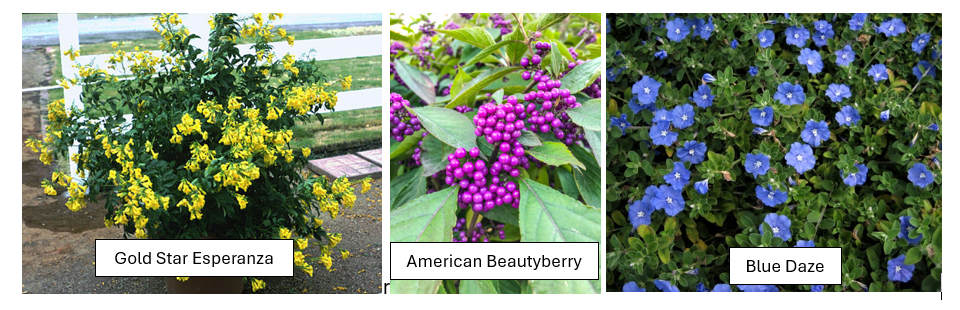
A few examples of Texas Superstars:
So…what is in your garden or landscape? Is it a Native? Is it a Superstar? Is it both? I encourage you to spend some time really learning the origins of your plants as you enjoy their beauty and encounter their benefits.
BCMGA offers several education programs each month. There is a program at 6:00 p.m. on the 1st Tuesday of the month at the South Library Branch in the Mall of Abilene, and the same program is offered again at 10:00 a.m. on the 2nd Friday of the month at the Downtown Library. Watch the BCMGA website and Facebook page for the topics and the dates of these monthly programs.
If you have any questions, call the Taylor County Extension Office at 325-672-6048 or email us at mgardeners@yahoo.com. We hope you visit bcmgtx.org for information on all Big Country Master Gardener events, like us on BCMGA Facebook, and check out training presentations on BCMGA YouTube. We are here to help you.
Resources:
Texas A&M AgriLife Extension Service (Agrilifeextension.tamu.edu) and Texas Gardener (Texasgardener.com).